

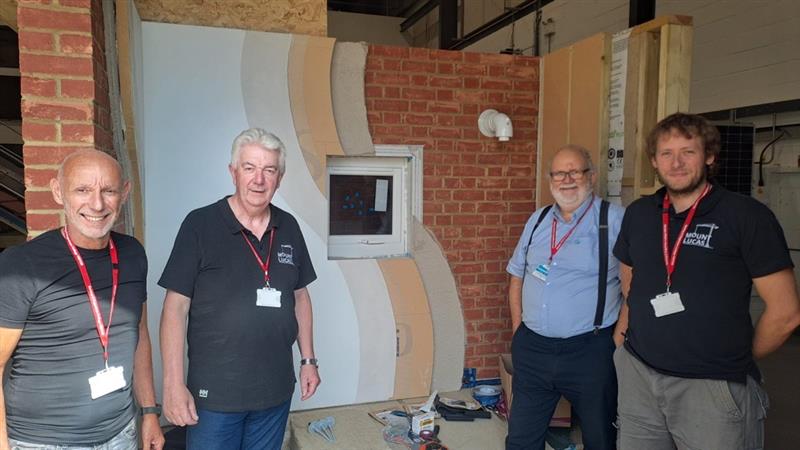
At Quantum, we recently had the chance to work with the team at Mount Lucas National Construction Training Campus during the design phase of our own facility. Their expertise on retrofit techniques and materials was invaluable in helping us create Retrofit Bays that are fit for practical training.
The Mount Lucas team provided guidance on key real-world retrofit challenges in a training context, such as roof, wall, and floor insulation, airtightness application, and ventilation installation and commissioning. This collaboration has helped us ensure our learners get hands-on experience with the full range of tasks they’ll face on site — equipping them with the skills and confidence to deliver high-quality retrofits in practice.
Mount Lucas is one of Ireland’s leading centres for construction and retrofit training, playing a vital role in upskilling workers to deliver high-quality, energy-efficient upgrades to homes across the country.
Curious to learn more about their work, we put together a short Q&A with Mount Lucas to explore how retrofit is approached in Ireland, what homeowners should consider before starting their own projects, and the key skills future retrofitters need.
1. In your experience, how has the introduction of PAS 2035 influenced retrofit practices and the way retrofit training is delivered at Mount Lucas?
In Ireland, retrofit operates under a different framework than in the UK, so PAS 2035 (a British standard) does not apply here. Instead, retrofit is driven by the Sustainable Energy Authority of Ireland (SEAI), which has established a system of One Stop Shops, Individual Grant Incentives, and Fully Funded Upgrades. All of these are underpinned by Irish Technical Guidance Documents and are monitored closely by SEAI.
- One Stop Shops – These provide a complete “start-to-finish” solution for homeowners or landlords. The service includes a home energy assessment, help with grant applications, management of contractors, and a follow-up BER. The aim is to deliver a package of measures that bring the home to a minimum B2 BER rating. Grants are deducted from the overall cost, and the homeowner pays the balance. Homes must be built and occupied before 2011 to qualify.
- Individual Grant Incentives – For those who prefer to manage their own project, SEAI offers a range of standalone grants for insulation, heating, and renewable technologies. Homeowners select SEAI-registered contractors, apply for the grant in advance, and then claim back funding once works are complete. Homes must be built and occupied before 2011 (for insulation and heating controls) or before 2021 (for renewables).
- Fully Funded Upgrades – For homeowners in receipt of qualifying social welfare supports (such as Fuel Allowance, One-Parent Family Payment, or Disability Allowance), upgrades are provided completely free of charge. SEAI manages the full process: a home assessment is carried out, contractors are assigned, and all works are fully funded. Homes must be built and occupied before 2006 to qualify.
At Mount Lucas, our retrofit training is aligned with these national frameworks. We train learners to deliver works in compliance with SEAI Technical Guidance Documents, ensuring that the workforce is skilled, competent, and able to support Ireland’s retrofit journey under its own system rather than PAS 2035.
2. For a homeowner with little or no experience in retrofitting, what would you recommend as the best first step to start improving their home’s energy efficiency?
The first step should always be to determine your budget and explore available grants or funding supports. An SEAI-registered assessor can then carry out a Building Energy Rating (BER) or Home Energy Assessment, which highlights the areas of greatest energy loss and prioritises where improvements should be made.
From there, retrofit can be approached in stages:
- Small, immediate steps: switch to LED lightbulbs, add heating and hot water controls, and ensure the heating system is zoned. These are low-cost measures that can make an immediate difference.
- Medium steps: insulate the attic and address draughts by sealing air leakage points (for example, around attic hatches with airtightness tapes). Deal with any maintenance issues — such as roof leaks or damp — before starting more advanced works.
- Major steps: replace windows and doors (ensuring airtightness tapes are used to seal back to reveals), insulate walls (internal, cavity, or external systems, depending on the building), and carry out an airtightness test to determine the correct ventilation strategy. Upgrading the heating system should then be done in line with the Heat Loss Indicator (HLI) achieved. Finally, install the appropriate ventilation system, which will depend on the home’s airtightness level.
By working step-by-step in this way, homeowners can improve energy efficiency at a pace that suits their budget, while ensuring all works are properly sequenced and effective in the long term.
3. In your view, what are the key signs of a poorly executed retrofit project? What should people watch out for?
A well-executed retrofit depends on careful planning, clear communication, and attention to detail. Warning signs of a poorly executed project include:
- Poor communication – no clear agreement between homeowner and contractor on the retrofit strategy, budget, or grant conditions before works begin.
- Unresolved pre-existing issues – structural or damp problems not addressed before retrofit measures are installed, which can undermine the upgrades.
- Competence gaps – contractors not providing proof that works are carried out by trained, qualified staff, or not sharing references from previous projects.
- Missing documentation – absence of product data sheets, specifications, or photographs of works as they progress, particularly for measures that will be covered up later.
- Failure to test and verify – airtightness tests not carried out before finishes are applied, meaning leaks are left unaddressed; ventilation provision ignored or blocked.
- Attention to detail – inadequate sealing around windows, attic hatches, or doors; vents (wall, soffit, roof) blocked by new insulation; “hole-in-the-wall” vents left unchecked, causing excessive draughts; or mould appearing due to poor ventilation or thermal bridging.
Technical checks are critical: for example, the Heat Loss Indicator (HLI) must be 2.3 or below for air-to-water heat pump systems (SEAI regulation), and if airtightness is 3 m³/hr/m²@50Pa or better, then mechanical ventilation must be installed.Finally, a proper handover meeting with the homeowner is essential. All documentation should be provided and explained clearly so the homeowner understands how their upgraded home should perform.
4. If you had to choose just one material or upgrade that makes the biggest impact on a home’s EPC rating, what would it be?
The answer depends on budget and the condition of the home:
- Lowest cost, biggest impact: tackling air leakage is often the most cost-effective measure. Using airtightness tapes to seal gaps around attic hatches, windows, and other openings can dramatically reduce heat loss. These measures are inexpensive, can often be done by the homeowner, and have an immediate effect on comfort and efficiency.
- High-cost, high-impact: if budget allows, replacing windows can have a huge impact. Heat loss through poor-quality windows is estimated to be up to eight times higher than through walls. High-performance glazing therefore represents one of the biggest single improvements in terms of heat retention.
- Heating system upgrades: for homes with older, inefficient boilers or systems, upgrading to a modern heating system can yield the greatest benefit. This not only reduces energy bills but also significantly improves the home’s EPC rating.
Each of these measures has merit, but airtightness, windows, and heating upgrades together provide the strongest combination for improving overall performance.
5. What are the three most important techniques or skills you believe every retrofit trainee should learn?
Retrofit is highly technical and requires a disciplined, team-based approach. The three most important skills or attitudes every trainee should bring to a project are:
- Work only within your professional competence/ skills set– trainees should only carry out tasks they have been trained for and always under supervision until fully competent.
- Understand the reasoning – rather than just following instructions, trainees must grasp why a task is being done, how it affects the building, and what impact it has on energy performance.
- Communicate and collaborate – trainees should ask questions, clarify when unsure, and maintain clear communication with other team members. Retrofit projects involve many different trades and disciplines, so teamwork is essential.
Alongside these, a strong awareness of health and safety is critical. Retrofit often involves working in occupied homes, where risks to both workers and householders must be carefully managed.
This Q&A offers a clear look at the planning and expertise that go into successful retrofit projects — from airtightness and ventilation strategies to contractor competence and communication.
We’re grateful to Mount Lucas for sharing their insights and for the guidance they gave us during the development of our Retrofit Bays. Their work continues to set a high standard for retrofit training in Ireland, and we’re excited to see the positive impact it will have in the years ahead.
Learn more about Mount LucasExplore our Green Skills Training Solutions